

Bring planning directly to your data in Microsoft Fabric
Build budgets, forecasts and scenarios directly on your Microsoft Fabric semantic models in one no-code planning platform.

A major milestone: Lumel becomes Fabric Planning
Fabric Planning is now available directly in Microsoft Fabric as a native ISV workload for enterprise planning.
Are your data, models and security rules already in Microsoft Fabric? Fabric Planning brings planning to that data instead of moving it into a separate proprietary platform.
Finance, sales, operations and HR teams can build and manage budgets, forecasts and scenarios in a familiar, collaborative and governed experience.
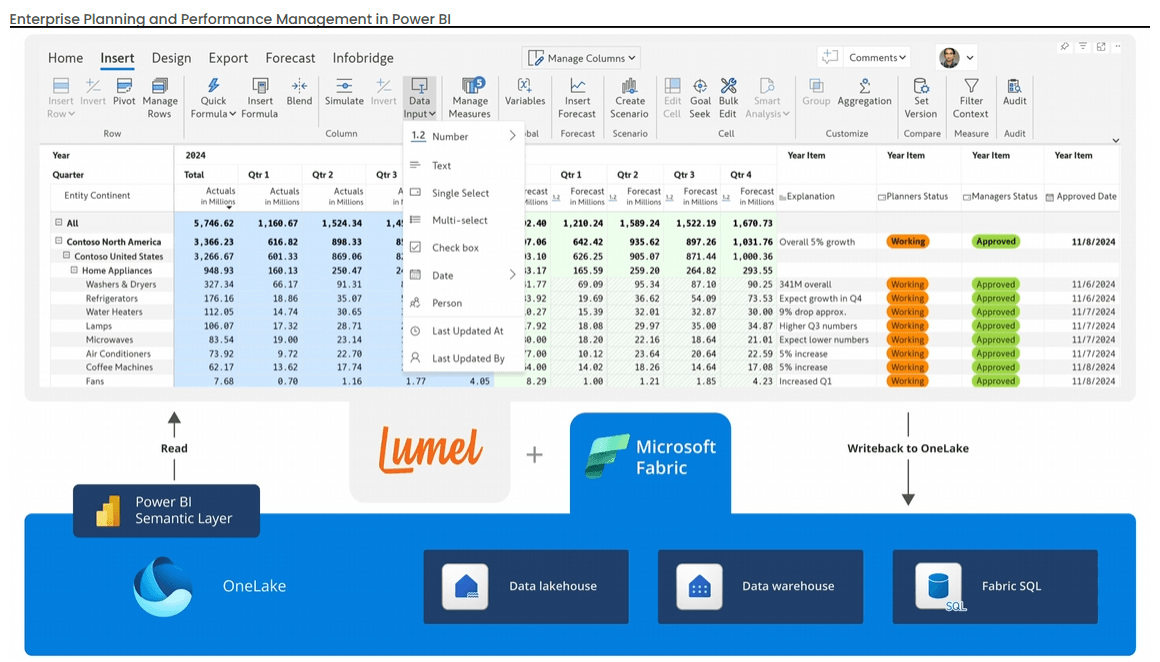
Every planning method, inside Fabric
Strategic plans, budgets, rolling forecasts or ad-hoc scenarios: Fabric Planning supports every method on one no-code platform.
Budgets, forecasts and scenarios
Strategic planning and rolling forecasts
Cascade multi-year objectives into operational targets and continuously update 12- to 18-month forecasts as actuals come in.
Advanced scenarios and simulations
Plan around headcount, volume, price and conversion drivers, then compare what-if assumptions and their P&L impact side by side.
Self-service and collaboration
Integrated collaboration
Cell-level comments, threaded conversations, multi-user input and challenge-approve workflows bring managers, controllers and business teams together.
A familiar no-code experience
Business teams create plans on existing semantic models through a spreadsheet-like interface, without remodelling or systematic IT dependency.
Connected and automated planning
Real-time connections between plans
Connect revenue, headcount, cash flow and OpEx so outputs from one plan automatically feed assumptions in another.
Automatic transformations
Aggregate, allocate, convert currencies and reclassify data as it flows, with no manual exports or reconciliation.
Event-driven updates
A changed assumption can instantly refresh downstream plans, from hiring targets to cash-flow projections.
How Lumel stands out
Discover what changes when planning is designed as a native Microsoft Fabric workload.
Native to Microsoft Fabric
Fabric Planning runs directly in your Fabric environment and uses your existing semantic models.
Data stays in OneLake
Plans and actuals coexist in Fabric, with no data duplication and no fragile ETL pipelines to maintain.
Read and write back
Read semantic models and write planning data directly back to Fabric, alongside actuals.
High-performance calculation engine
Structured budgets, allocations, ad-hoc scenarios and simulations run on an enterprise planning engine.
Fabric security inherited
Fabric Planning uses your existing Entra ID and workspace-level security.
Usage-based pricing
Fabric consumption replaces per-seat licensing, opening planning to every contributor who needs it.

Microsoft announces a shared vision and collaboration with Lumel
"Our strong collaboration with Lumel reinforces Microsoft's commitment to providing a single, unified platform where planning and analytics coexist, helping organizations make better decisions faster."
For finance teams, this means:
The end of dependency on scattered Excel files, sources of errors and slowdowns.
An ability to anticipate, simulate and decide faster, in an uncertain economic context.
Continuous planning — rolling forecasts, sensitivity scenarios and simulations — embedded in daily operations.
Connected plans across finance, sales, HR and operations, updated in real time.
Unified performance management in Microsoft Fabric, without duplicating actuals or adding another ETL pipeline.
Why choose PerfectSight?
Integrator – advisor: our DNA is to help you choose the most appropriate technology tools for your needs and make your EPM projects a success.
What you want to avoid
- ✗EPM projects that stretch over 18 months and mobilize dozens of people
- ✗Spending all day consolidating numbers instead of analyzing and deciding
- ✗Producing reports "for show", with no real impact
What we bring
- Modern, integrated and configured EPM solutions, without technical dependency
- Functional deployments in 3 to 6 months, delivered in batches
- Pre-built and customizable business models
What you gain
Time
Your teams shift from data manipulation to analysis and decision-making
Visibility
A single tool shared between finance and business, up-to-date data, a common language
Impact
Analyses and simulations that truly fuel strategy, not just spreadsheets
Let's talk about your project
Questions, demo requests, registrations & information: we'll get back to you as soon as possible.
Address
32 rue Arago, 92800 Puteaux, France